The Challenge
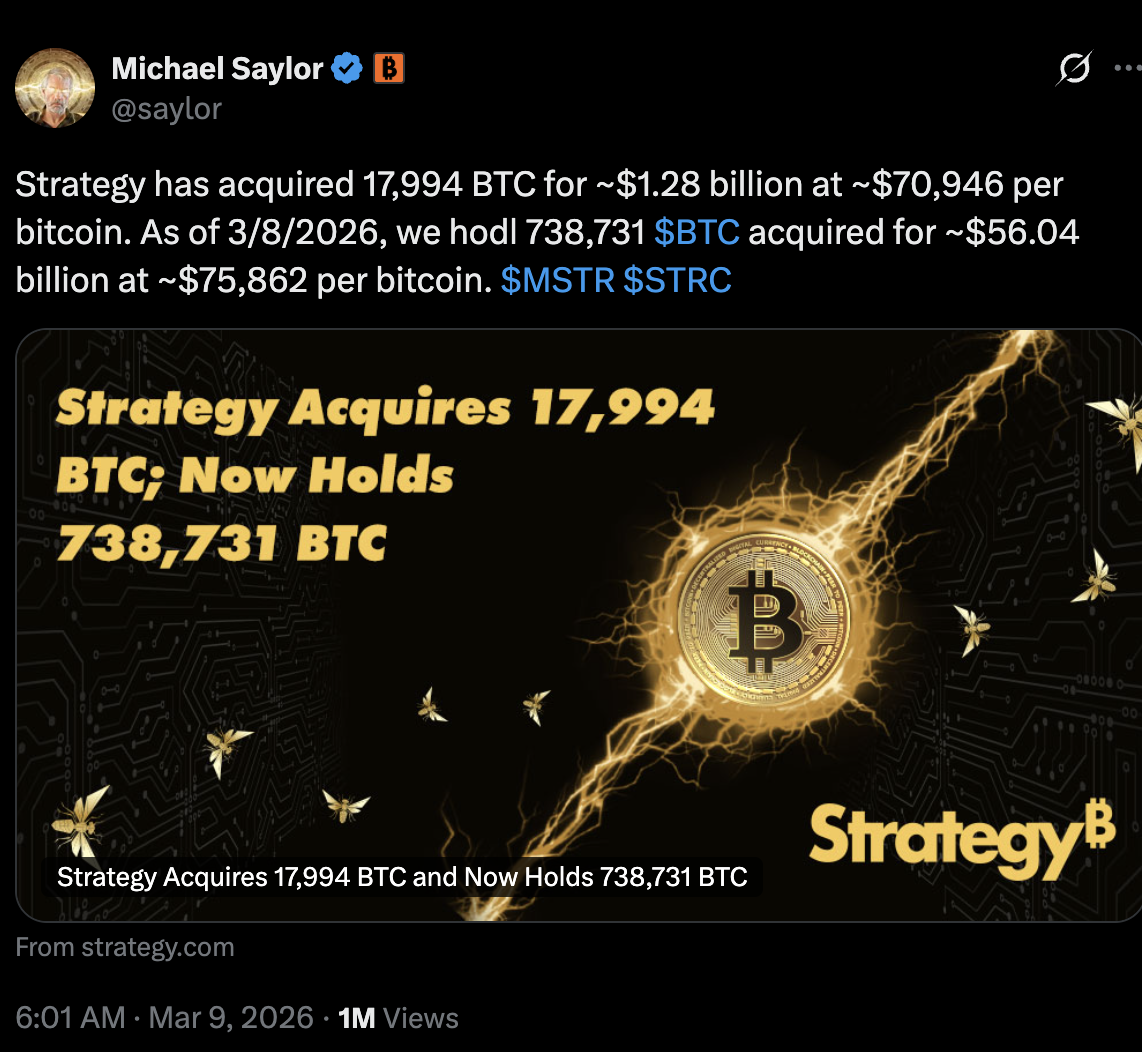
Between March 2-8, 2026, Michael Saylor's Strategy acquired 17,994 BTC for approximately $1.28 billion at an average price of ~$70,946 per Bitcoin.
This challenge asks: could you have done it better?
How Scoring Works
Your score is the 1-year effective price per BTC — a single number that captures both execution quality and capital efficiency.
Effective Price = (Execution Cost + Net Annual Holding Cost) / BTC Delta
Execution cost is what you actually pay to acquire the delta — including fees, spreads, slippage, and option premiums.
Net annual holding cost is the cost of maintaining your position for one year, minus any yields. Capital sitting in T-bills earns 3.5%. Capital locked in spot BTC or margin doesn't. Perpetual funding rates, futures basis costs, and options theta all count.
Saylor bought spot and held. His effective cost: ~$70,946 execution + ~$44.8M opportunity cost (3.5% on $1.28B locked capital) = $73,429/BTC.
Constraints
- $1.28B notional BTC delta required (~17,994 BTC)
- 7-day execution window (March 2-8, 2026)
- Any instruments allowed — spot, futures, options, swaps, OTC, whatever
- Risk-free rate: 3.5%
- Holding costs assumed constant over the hold period
The Judge
Strategies are evaluated by an AI execution specialist. The judge is skeptical by default — it estimates realistic market impact, penalizes unrealistic assumptions, and assesses creative strategies from a probability-of-success angle with a skew toward pessimism.
$1.28B is a significant portion of daily BTC volume. The judge knows this and will price in the market impact you're creating.
Rate Limits
10 submissions per hour. Log in with X to submit.